


Their Only Chance is a powerful painting by Arthur Henry Howard Heming (1870 – 1940), up for sale at Cowley Abbot fine art. The catalog carries this must-read, vintage article from the 1937 Illustrated Sporting and Dramatic News, a British weekly magazine. It’s classic “purple prose,” ornate, flowery and full of pumped up metaphors. But it’s definitely accurate to the most dramatic moments of escaping a Canadian forest fire.

Readable Text of the article:
NORTH WOODS DRAMA
The Forest Fire-Realistic Impressionism by a Great Canadian Painter
Brushwood and spruce burning down in a crackling cataclysm, like the shots of a battle, to the water’s edge-an impending, fiery wall, advancing with unargumentative relentlesness, the night sky lit for miles by its glowing crescendo, the immediate distance a burning, Dantesque unreality. The skeletons of trees crackle and burst like shells, the flames sear the night. And in the foreground, on the bosom of an imperturbable, sliding river, the panic of the old world and the new, the driving, sliding force of the great scow with its six straining rowers, its earnest, shouting helmsman. And nearer, the swimming bear, the ball-moose forging. The foam rises about his quarters like solid lace. The flames seem to roar with an almost audible intensity. The urge to escape is the paramount theme. This picture of a Canadian forest fire at night is merely one of several painted by that great artist, Mr. Arthur Heming, who, we prophesy, will one day be world-famous. It was bought not long since by General Motors of Canada, Ltd., and we reproduce this by courtesy of the artist’s agents, Messrs. Frost and Reed, of Clare Street, Bristol, and King Street, St. James’s
Heming gained international recognition during his career for his dramatic paintings of the Canadian wilderness, “symbolizing the country as a mythic ‘Great White North’ in the minds of millions”, according to curator Cassandra Getty. His livelihood was as a dynamic creator of illustrations for books and publications.

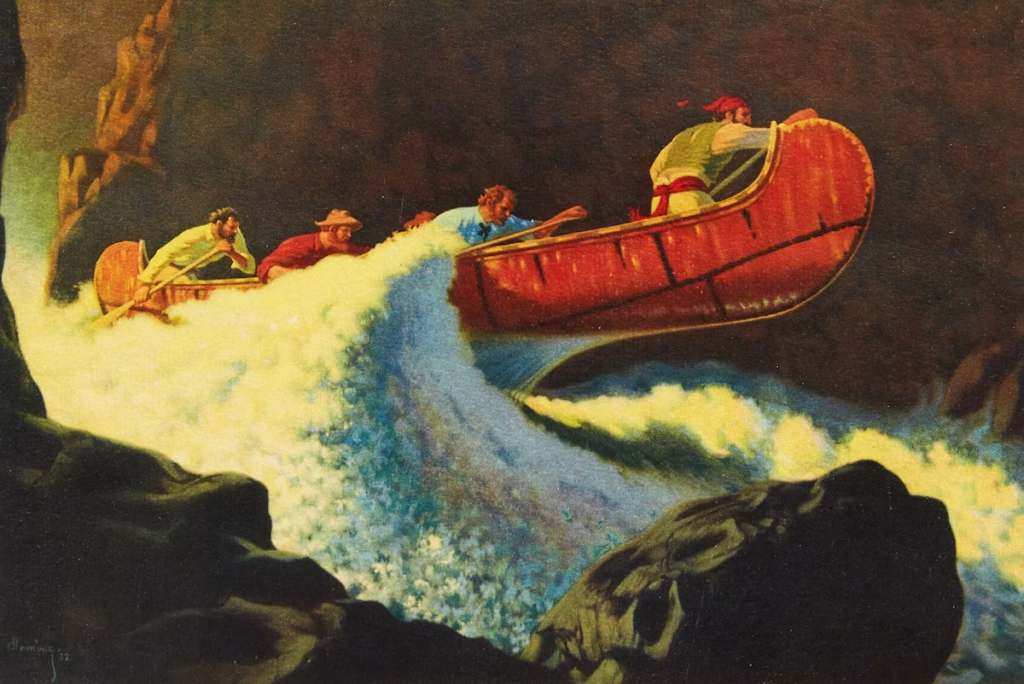
The exaggerated action of a raft crashing over the rapids of the rushing Ottawa River, being tossed and turned by the current of the water, the men clinging on for life, is a moment of heightened drama. Calumet Island on the Ottawa River acted as a link in the western route to the Great Lakes. It was one of the roughest sections of the Ottawa River that was traversed by missionaries, fur traders and loggers – now beloved by white water rafter enthusiasts – Cowley Abbot
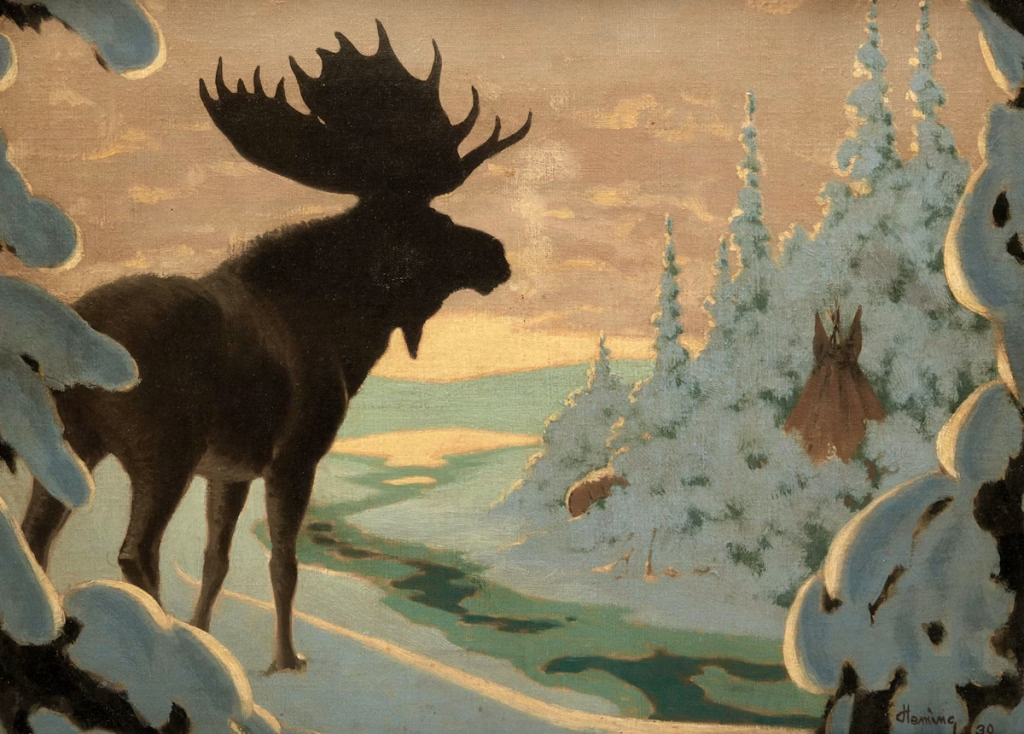
Heming’s works vividly reflect the adventures he experienced on rugged travels throughout the backcountry of Canada. Heming’s power as a painter was in his decision to depict thrilling, sometimes tragic incidents, leaving the softer, more sentimental side of nature to his contemporaries.
Heming gained international renown as the “chronicler of the North”, through his vivid depictions of Canada’s northlands in paintings, sketches, essays and books.

Born in Paris, Ontario and raised in Hamilton, he studied at the Hamilton Art School, then in New York City at the Art Students League with Frank DuMond, and the Old Lyme Art Colony, and in London with the Welsh master Frank Brangwyn.

Heming painted scenes depicting the fur trade, many for the book The Drama of the Forests. He asked the Hudson’s Bay Company to include his work in their collection as a contributor to the history of Canadian wilderness exploration. Instead, in 1921, the Royal Ontario Museum purchased a selection of these paintings, which Maclean’s magazine then reproduced as covers throughout the early 1920s.
A long biography of Henry Howard Heming at Cowley Abbott
More about Heming and his relationship to members of the Group of Seven at the National Gallery
A visual survey of his paintings on artnet
More detail on the painting Their Only Chance, circa 1937

This is No. 85 in 150 Artists, an ongoing series on Canadian artists you should know.
Discover more from Canadian Art Junkie
Subscribe to get the latest posts sent to your email.


Leave a Comment