

You may think you know all about Frank Gehry (1929-2025), one of the world’s most celebrated architects. He was a Canadian whose works in this country are instantly recognizable (think Art Gallery of Ontario or Toronto’s Forma), and whose buildings elsewhere brought him international fame.


But it took Gehry many decades to come fully into his prime as an architect and while he was rising, he was perfecting his design talent by focusing on sculptural works.
Born in Toronto in 1929, and transplanted to Los Angeles at 18 in a family move, Gehry studied architecture at the University of Southern California, and Harvard. In the early years, his penchant for bold, postmodern shapes and unusual fabrications developed as he sculpted and designed furniture, much of it just as modernistic as his later buildings.

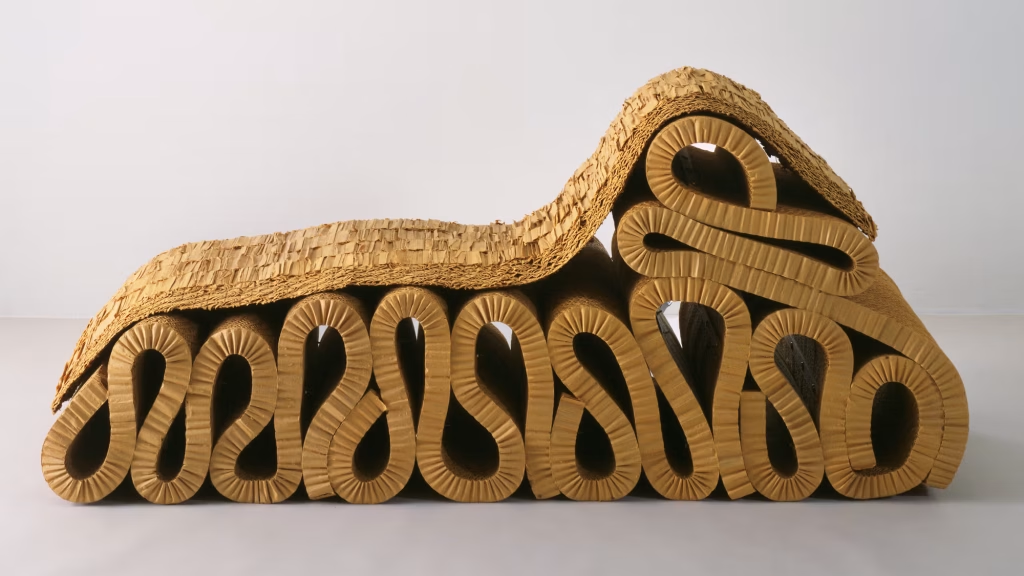
The early career work reflected Gehry’s focus on inventive forms made from unexpected materials. These series of chairs and tables, Easy Edges (1969–73, above) and Experimental Edges (1979–82, below), were made of industrial corrugated cardboard.

A later Knoll furniture series (1989–92) was made from pliable bentwood. Below, the High Sticking™ Chair designed in 1990.


After three years of experimentation and exploration, the Knoll collection (with each piece named for hockey teams) debuted in the Frank Gehry: New Furniture Prototypes show at The Museum of Modern Art.
Gehry’s Sculptures
In 1999, Gagosian held Gehry’s first sculptural presentation in a commercial U.S. gallery. It was simply called A Study (below).


The Gagosian Gallery describes it as “. . . a vaulting structure of shaped wood ribs, overlaid with thin strips of maple, then clad with a dramatically sculpted “skin” constructed from 16,000 pounds of overlapping shaped sheets of gray lead. The form measures approximately 20 feet high, 25 feet wide, and 40 feet long. Because of its open configuration, the viewer can enter the sculpture and walk entirely through its cave, or shelter-like interior. In this way, it epitomizes Gehry’s complex fusion of sculpture and architecture. “

One of Gehry’s most recent works – Untitled (Fish on Fire, Greenwich Street) – went on display in the 3 World Trade Center lobby in February, 2025. The 20 x 7 ft piece was created in collaboration with Silverstein Properties and the Gagosian Gallery.
His Fish Lamps

Colorcore Formica, stained and lacquered plywood, glass 37½ h × 40 w × 24 d in (95 × 102 × 61 cm)
“The fish is a perfect form.” – Frank Gehry
Gehry’s Fish Lamps evolved from a 1983 commission by the Formica Corporation to create objects from the then-new plastic laminate ColorCore. After accidentally shattering a piece of it while working, he was inspired by the shards, which reminded him of fish scales.

The first Fish Lamps, fabricated from 1984 to 1986, employed wire armatures molded into fish shapes, onto which shards of ColorCore are individually glued. The series continued in 2012 on a larger scale. These sculptural designs reflect Gehry’s longstanding fascination with the fish.

The fish became a recurrent motif in Gehry’s work, as much for its “good design” as its iconographical and natural attributes. It informs the lines of the Guggenheim Museum in Bilbao, Spain (1997); the Jay Pritzker Pavilion in Chicago (2004); and the Marqués de Riscal Vineyard Hotel in Elciego, Spain (2006) as well as the Fish Sculpture at Vila Olímpica in Barcelona (1989-92) and Standing Glass Fish for the Minneapolis Sculpture Garden (1986).
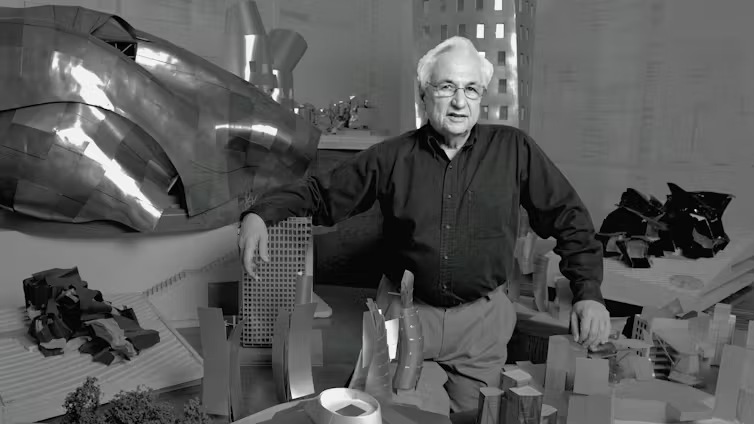
There is plentiful information onlne about Gehry, his history, his works and his art forms. This CBC News item is from the time of Gehry’s passing in December, 2025.
Biography of Frank Gehry, here.
15 Iconic Architecture Projects, here.
The Gagosian Gallery pages on Frank Gehry, here.

This is No. 74 in 150 Artists, an ongoing series on Canadian artists you should know.
Discover more from Canadian Art Junkie
Subscribe to get the latest posts sent to your email.


Amazing work, really!
Wow! I knew the chairs, had seen them,, or some of them anyway, in the Gehry-powered AGO, but I did not know the fish, the lamps, the other displays. That 1999 Gagosian “Study”! Just glorious. I bet Henry Moore would have been fascinated… Thank you.
You’re so welcome. I thought exactly the same thing (Henry Moore) when I saw the Gagosian Gallery sculpture. What a wonder.
While I am a pretty staid marine carver these days, back in the sixties and early seventies, Gehry was a huge influence on me. Thank you for this impressive review of his work. Damn! I gotta get out to the shop. Those fish!
I am always fascinated by how the artists on this site have influenced others, including you. Thank you. And yes, those fish! Now to the shop!